
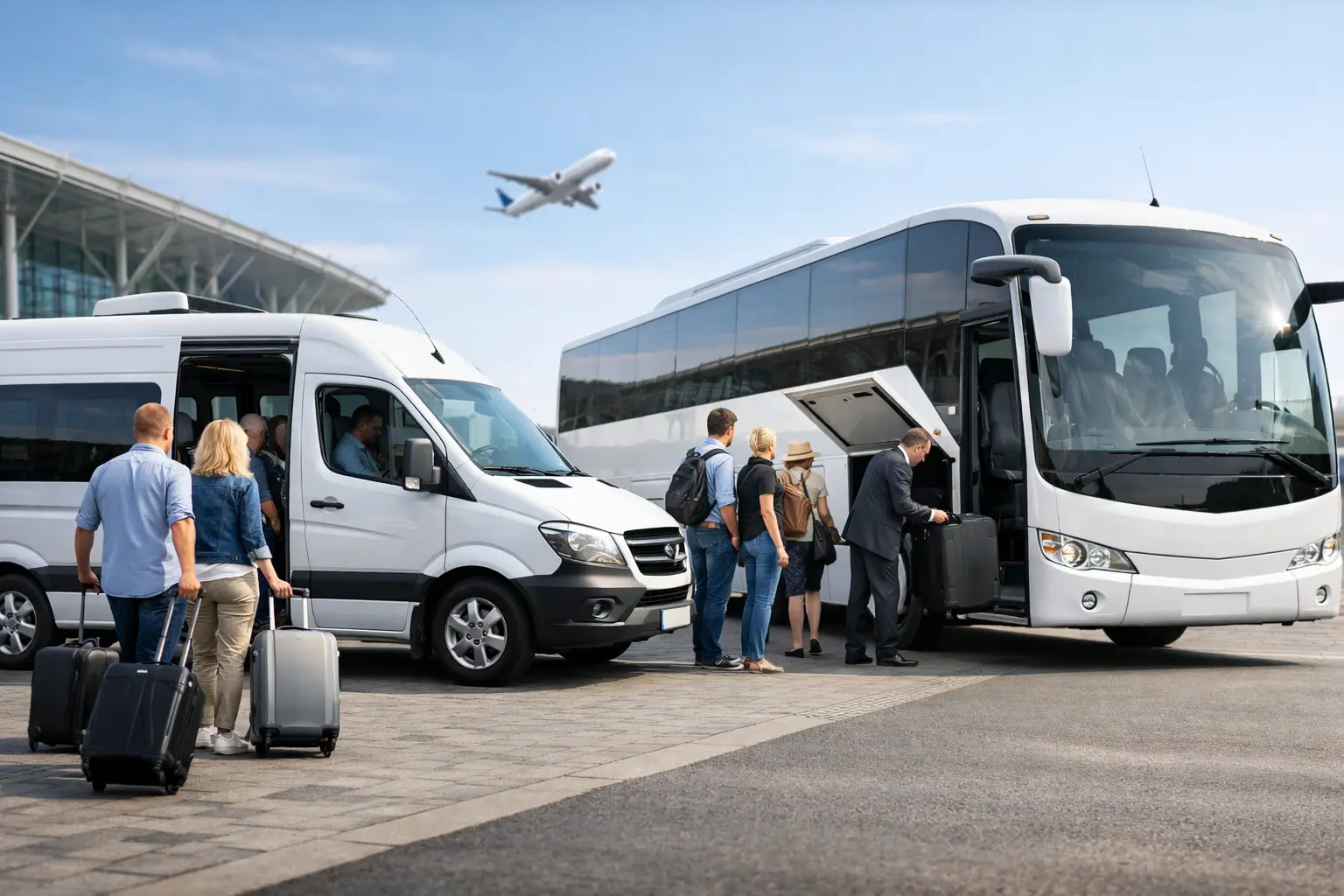
A minibus vs coach transfer decision is rarely just about passenger numbers. A group of 16 arriving at Sofia Airport with ski cases needs something very different from 16 colleagues travelling to a conference in Plovdiv with hand luggage. The right vehicle keeps everyone together, protects the timetable and makes the journey comfortable from door to door.
For organised travel in Bulgaria, the best choice comes down to four practical details: how many people are travelling, how much luggage they have, how far they are going and how much time they will spend on board. Booking a vehicle that is too small creates avoidable stress. Booking one that is much larger than needed can add unnecessary cost.
Minibus vs coach transfer: the practical difference
A minibus is generally the natural choice for small and medium-sized groups. Depending on its layout, it may carry around 8 to 20 passengers, with a separate or rear luggage area. It is easier to manoeuvre outside hotels, city-centre addresses, mountain resorts and smaller villages where access can be tighter.
A coach is designed for larger groups and longer shared journeys. Coaches commonly accommodate 25 to 60 passengers and offer more substantial luggage holds below the passenger cabin. They are particularly useful for airport groups, corporate events, wedding guests, school or university travel, sightseeing programmes and transfers between Bulgarian cities.
Capacity figures alone can be misleading. A 19-seat minibus may not be suitable for 19 adults with full-size suitcases. Equally, a 50-seat coach may be the sensible option for 35 passengers carrying sports equipment, pushchairs or bulky exhibition materials. The usable capacity is always shaped by luggage.
When a minibus is the better choice
Choose a minibus when your party is travelling as one group but does not need the scale of a full coach. It offers a more personal setting and is often the most efficient option for families, groups of friends, airport arrivals, team travel and smaller business delegations.
For example, a party of 10 travelling from Sofia Airport to Borovets or Bansko can usually travel comfortably in a minibus, provided the luggage requirement has been confirmed in advance. The vehicle can collect the group close to the terminal exit, handle resort roads more easily than a large coach and avoid splitting passengers across several cars.
Minibuses also work well for point-to-point transfers where the destination is a central hotel, private villa or business address. Their smaller size can make collection and drop-off more straightforward, particularly where parking space is limited.
The trade-off is that the passenger cabin and luggage space are more closely connected. On a longer route, every seat and bag matters. If people are bringing large suitcases, golf bags, ski equipment or equipment for an event, moving up to a coach may give the group a much more relaxed journey.
When a coach makes more sense
A coach is usually the better solution once a group becomes large enough that several minibuses would be required. Keeping everyone on one vehicle makes attendance checks, departure times and luggage handling far easier. It is also more suitable for groups travelling with a coordinator, guide or event organiser.
For long-distance routes such as Sofia to Burgas, Sofia to Varna, Plovdiv to Bansko or airport transfers for a large holiday group, a coach gives passengers more room to settle in. Larger luggage compartments keep bags out of the seating area, leaving the cabin clear and comfortable.
A coach can also be more cost-effective per passenger. While its overall price will be higher than a minibus, the cost shared across 30, 40 or 50 travellers may be considerably better than arranging multiple smaller vehicles. For an organiser, one driver, one meeting point and one departure time reduce the number of moving parts.
The consideration is access. A coach needs adequate space to approach, park and turn safely. This is rarely a problem at airports, conference venues and major hotels, but it should be checked for remote properties, narrow old-town streets and mountain accommodation. A professional transfer provider will confirm the collection and drop-off details before travel rather than leaving this to chance.
Think about luggage before counting seats
Luggage is the most common reason a vehicle that looked right on paper becomes unsuitable on the day. Airport groups often travel with one large suitcase and one cabin bag each. Families may need child seats, pushchairs and extra bags. Winter guests may have skis, snowboards and boots. A corporate group can arrive with display stands, product samples or presentation cases.
When requesting a quote, give an honest picture of what each passenger will bring. It is helpful to specify the number of large suitcases, cabin bags and oversized items rather than simply saying “normal luggage”. If the group is still finalising numbers, plan for the likely maximum. A little extra room is far more useful than trying to fit a final bag onto someone’s lap.
This is also why a 16-passenger coach can sometimes be a better choice than a 16-seat minibus. The coach may offer a lower seat count but much greater luggage capacity and personal space.
Comfort changes with journey length
For a short airport transfer into Sofia, a suitable minibus may be all a group needs. For a three, four or five-hour journey across Bulgaria, comfort becomes more significant. Seat spacing, aisle room, climate control and the ability to keep bags stored properly all affect how passengers arrive.
On longer journeys, a coach is often easier for mixed-age groups, business travellers preparing for meetings and guests heading straight to an event. It provides more room to move and a calmer environment when the vehicle is fully occupied.
That does not mean a coach is automatically better for every long route. A group of eight or 12 people may still prefer the direct, private feel of a minibus. The key question is whether the vehicle will feel comfortably occupied for the whole journey, not merely whether every passenger can technically be seated.
Consider the itinerary, not just the transfer
A one-way airport collection is simple. A multi-stop itinerary needs more planning. If your group is visiting several locations, attending a wedding, travelling between meetings or combining city and resort stays, discuss the schedule from the beginning.
A minibus can be particularly useful for flexible smaller-group itineraries, where access to individual hotels or restaurants matters. A coach is often more practical for a fixed programme involving a large number of people and recognised pick-up points.
For either option, allow time for flight delays, baggage collection, passenger headcounts and loading. A reliable transfer is not only about the vehicle arriving on time. It is about having a clear meeting arrangement, a driver who knows the route and a realistic schedule that does not rush the group.
How to choose the right vehicle with confidence
Before booking, share the full journey information with your transport provider. Four details make the recommendation much more accurate:
- the final number of adults and children travelling;
- the number, size and type of bags or oversized equipment;
- every collection and drop-off address, including any planned stops;
- flight details, travel dates and the required arrival time.
Ask whether child seats can be provided if they are needed, and make sure the group understands the meeting point at the airport or venue. For early-morning departures, late-night arrivals and connections with limited time, advance booking offers the certainty that on-demand transport cannot always provide.
At Truedrivers, the vehicle recommendation is based on the real journey, not only a seat number. From family airport collections to nationwide group transfers, the aim is to provide a clean, properly maintained vehicle, a professional driver and clear communication before the trip.
The best vehicle is the one that leaves your group with enough room for people, luggage and peace of mind. Send the passenger numbers, route and luggage details before you book, and you can start the journey knowing everyone has a place.