
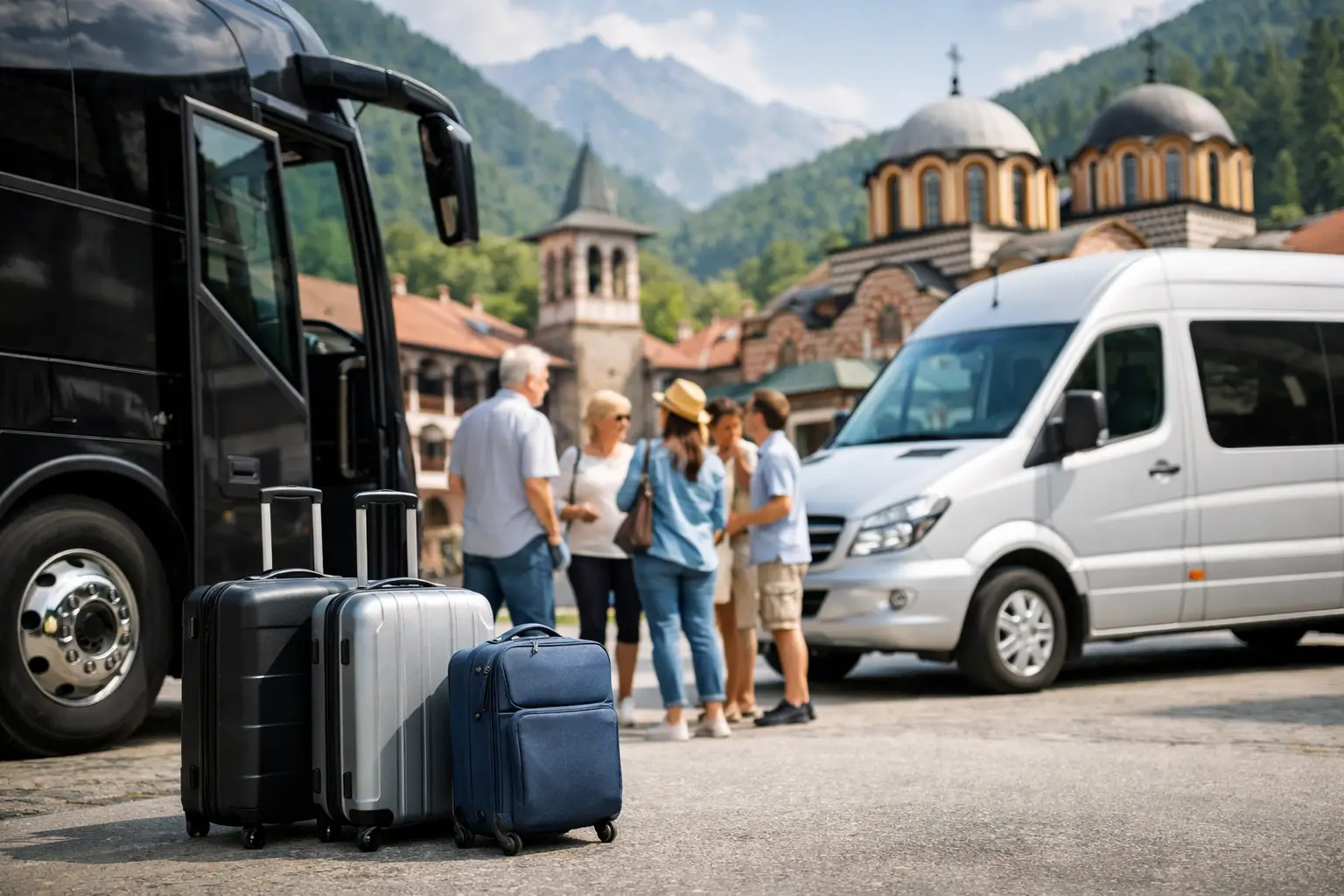
A group arriving at Sofia Airport after a late flight does not need a search for several taxis, a debate over luggage space or a driver who cannot find the hotel. A clear guide to group transport booking starts with one aim: make sure everyone travels together, comfortably and on time. Whether you are arranging a family holiday, a company visit, a wedding party or an intercity journey, advance planning turns a complicated arrival into a straightforward transfer.
Start with the real size of your group
The number of passengers is only the first part of the booking. A vehicle that technically has enough seats may not be the right choice if every traveller has a large suitcase, ski equipment, a pushchair or hand luggage for a long flight. For airport collections, luggage capacity is often the deciding factor.
Give your transport provider the exact number of adults and children, including infants. If children need car seats, say so when you book rather than relying on availability on the day. Family travel is easier when the vehicle and child seats are prepared before your flight lands.
It also helps to consider how the group will feel after the journey. Eight people can fit into a large van, for example, but a longer route from Sofia to Bansko, Plovdiv or the Black Sea coast may call for extra room. A minibus can be the better choice for comfort, even when a smaller vehicle appears sufficient on paper.
For larger parties, coaches and buses keep the group in one place and simplify coordination. This is particularly useful for conference delegates, sports teams, school groups and guests travelling between a hotel, venue and airport. The right capacity reduces delays at every stop.
Choose a vehicle for the route, not just the passenger count
Group transport is not one-size-fits-all. The best vehicle depends on the route, the time of travel and what the group needs during the journey. A compact group heading from Varna Airport to a nearby resort has different requirements from a business team travelling from Sofia to Burgas.
For five or six travellers with moderate luggage, a people carrier or large van can be practical. Mid-sized groups usually benefit from a minibus, while groups of several dozen passengers need a coach or bus. Ask what luggage space is included rather than assuming every seat comes with room for a full-sized case.
Route conditions matter as well. Bulgaria has excellent main roads between many major cities, but travel times can vary with mountain conditions, summer traffic towards the coast, border crossings and roadworks. A professional provider can recommend a suitable departure time and vehicle type based on the actual journey, not an optimistic estimate on a map.
Comfort is also a sensible consideration. For a short city transfer, a standard group vehicle may be all that is needed. For a multi-hour transfer, comfortable seating, air conditioning, planned stops and sufficient storage make a genuine difference. If any passenger has reduced mobility, notify the provider early so access and seating can be considered properly.
What to provide when booking group transport
A good booking request gives the transport team enough information to plan without repeatedly chasing details. It also protects your group from avoidable misunderstandings. Include the essentials from the start:
- the date, collection time and complete pick-up and drop-off locations;
- the number of passengers, children and requested child seats;
- the number and type of bags, plus unusual items such as skis, musical instruments or golf clubs;
- flight number and arrival time for airport collections;
- a lead passenger’s mobile number, ideally available on messaging apps;
- any planned stops, return journey details or accessibility requirements.
For an airport transfer, the flight number is particularly valuable. It allows the driver or operations team to follow the arrival and respond if the flight is delayed. Still, tell the provider if your itinerary changes. Flight monitoring supports a smooth collection, but direct communication remains the quickest way to resolve a last-minute change.
If your group has a strict schedule, such as a cruise departure, conference registration or wedding ceremony, share the fixed time. The collection time should allow for traffic, luggage collection and the practical pace of moving a larger party. Leaving 15 minutes late may feel minor at a hotel, but it can become a serious problem when ten people are involved.
Confirm what the price and service include
A low headline price is not always the lowest-cost group option. Splitting a party into separate taxis can create extra waiting time, inconsistent service and unexpected charges. A pre-booked private vehicle gives the organiser one confirmed plan and a single point of contact.
Before confirming, make sure you understand whether the quoted price covers the complete route, tolls, parking, waiting time and any planned stops. Ask about the policy for flight delays, changes to passenger numbers and cancellations. This is not about expecting trouble. It is about knowing where you stand if travel plans shift.
For corporate travel, request the information needed for expense records or invoicing before the journey takes place. For holiday groups, make sure the lead traveller knows how payment is handled and whether any balance is due before collection. Clear arrangements prevent an awkward conversation when everyone is tired or trying to leave the airport.
It is also worth checking the practical service standards. Is the transport pre-booked for your exact time? Will the group receive a confirmation? Is customer support available if your flight lands at midnight or a border delay affects your plans? These details are often more valuable than a small difference in price.
Plan the collection point carefully
Many group transfers fail at the first five minutes because passengers and drivers are looking in different places. At airports, agree how the driver will identify the lead passenger and where the meeting will take place. At hotels, provide the full property name and address, especially where similarly named accommodation exists in different resorts or towns.
For private addresses, give a pin or clear local directions if access is difficult. This is useful in mountain villages, rural properties and old town streets where larger vehicles may need to stop nearby rather than directly outside the door. A good provider will explain any access limitation in advance and help set a practical meeting point.
Keep one person responsible for communication. Everyone in the group does not need to message the driver. A nominated lead traveller can confirm that the group has landed, report a delay at baggage reclaim and make sure no one has been left inside the terminal. It sounds simple, but it saves time when a group is tired or spread across several queues.
Allow time for the parts people forget
Airport arrival time is not the same as ready-to-leave time. Passport control, luggage belts, lost baggage reports, cash machines and toilets all take longer when several people are involved. International groups may also have different arrival procedures depending on their journey and documentation.
For departures, build in time for hotel check-out, loading luggage and collecting passengers from separate rooms or buildings. If you are travelling to Sofia Airport, Varna Airport, Burgas Airport or Plovdiv Airport, confirm the terminal and airline before setting off. A professional driver can help with the route, but only the organiser can ensure the correct flight information has been passed on.
For long-distance travel, discuss rest stops beforehand. A group with children or older passengers may need a different plan from a group of colleagues on a direct business journey. There is a trade-off: fewer stops shorten the route, while planned breaks make the journey more comfortable. The sensible choice depends on the passengers and the distance.
A guide to group transport booking for events and business travel
Events need more than a vehicle. They need a transport plan that works when schedules change. For conferences, arrange collection windows around flight arrivals rather than relying on a single time if delegates are landing on different services. For weddings and celebrations, consider separate outward and return transfers, especially when guests will not all leave at once.
Business groups should share a concise itinerary with the transport provider: flight details, hotel, office or venue address, number of journeys and the main contact for each movement. This makes it easier to adapt when a meeting runs over or an arrival is delayed. Privacy and punctuality matter, but so does having someone available who can respond quickly.
If your group is travelling across Bulgaria over several days, booking each leg in advance creates certainty. You know who is collecting you, what vehicle is expected and how the party will move between cities. This is often simpler than arranging local transport separately in every destination.
Reconfirm before you travel
A short reconfirmation message the day before collection is one of the best habits for group organisers. Check the date, local collection time, address, passenger count, vehicle, lead contact number and flight number. If the journey is early in the morning or late at night, this reassurance is especially useful.
Keep the confirmation available offline as well as on your phone. Mobile data can be unreliable immediately after landing, and a screenshot of the driver details or booking reference is useful if reception is poor. Ask your group to be ready a few minutes before the agreed time, with luggage packed and passports to hand where needed.
The right transport booking should let your group focus on the reason for the trip, not the logistics behind it. For dependable airport, intercity and organised group travel in Bulgaria, Truedrivers can help you choose the appropriate vehicle and confirm every detail before the road journey begins.